Case study
Better Than a Binder.
New school-finance staff in Texas have to learn fund accounting, grant compliance, and a handful of state reporting systems. A regional education service center asked us for a better way to onboard people than a three-ring binder. We gave them a leaderboard.
- Client
- A regional education service center in Texas
- Scope
- Training tool: question bank, scoring, leaderboard, feedback loop
- Stack
- Python · Flask · SQLite · no-framework front end
- Status
- Live — in daily use by finance staff
No Shortcut to Knowing the Rules
No single rule in school finance is especially hard. The problem is that there are thousands of them. Debits and credits lead to fund accounting, which leads to FASRG coding, federal grant rules, PEIMS, FIRST, recapture, and whatever the latest legislative session just changed. Most organizations deal with this by having new staff shadow a veteran for a year or two—but veterans are in short supply.
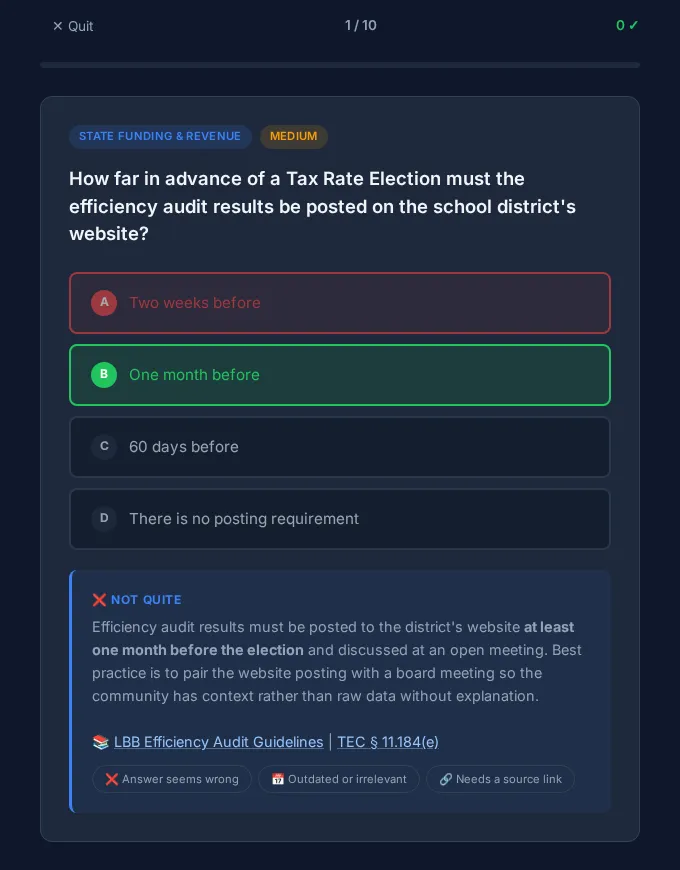
So we built a quiz. More than 200 questions across seven categories, ranging from what a debit is to the deadline for posting efficiency-audit results before a tax rate election. Every question includes a citation—TEA guidance, the Education Code, GASB, federal regulations—and an explanation. The goal isn't trivia. It's teaching people where to find answers.
Why They Keep Playing
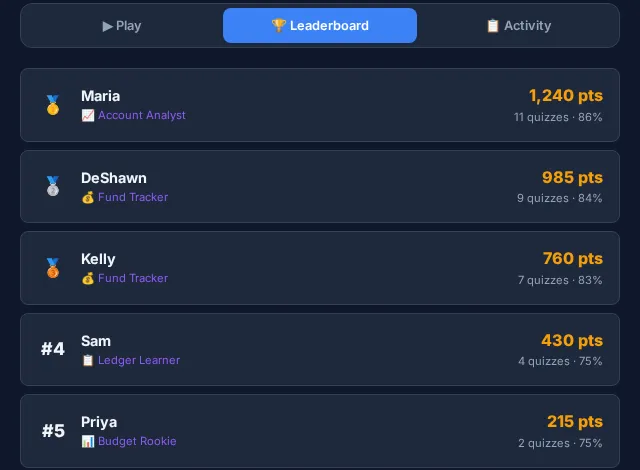
The game features are traditional on purpose. Players earn points for every correct answer, with bonus points for harder questions and streaks. They earn titles. The whole office can see the leaderboard. There are no log-ins or passwords—players just pick their name and start, because busy adults shouldn't have to clear hurdles before using a training tool.
We also let players earn points by improving the game itself. They get credit for flagging questions that seem wrong, out of date, or poorly sourced, and for submitting new questions. The question bank started with 55 questions. It's about four times that size now, and the growth came from the people using it. Flagged questions get checked against the sources, which keeps the content honest.
The quiz is live, self-hosted, and competitive. Staff at the service center now study school finance by choice—which, in the end, was the whole point.
Start your project